Ebb & flow aquaponics, also called flood-and-drain, is a media-bed configuration in which water repeatedly rises through the growing media and then drains away. A continuously running pump with an autosiphon, or a timed pump with a suitable drain, can create the cycle. The important feature is the changing bed water level—not whether the pump runs continuously.
This is a configuration within Media Bed Aquaponics. Use the system comparison hub to compare media beds with DWC and NFT.
Original Experience / What We Built
The original UFF article described ebb and flow as the first system the author started with. It documented an elevated grow-bed layout with growing pipes above it and gravity returning water to a fish tank. That is useful firsthand design history; it does not establish that the same system is still running today.
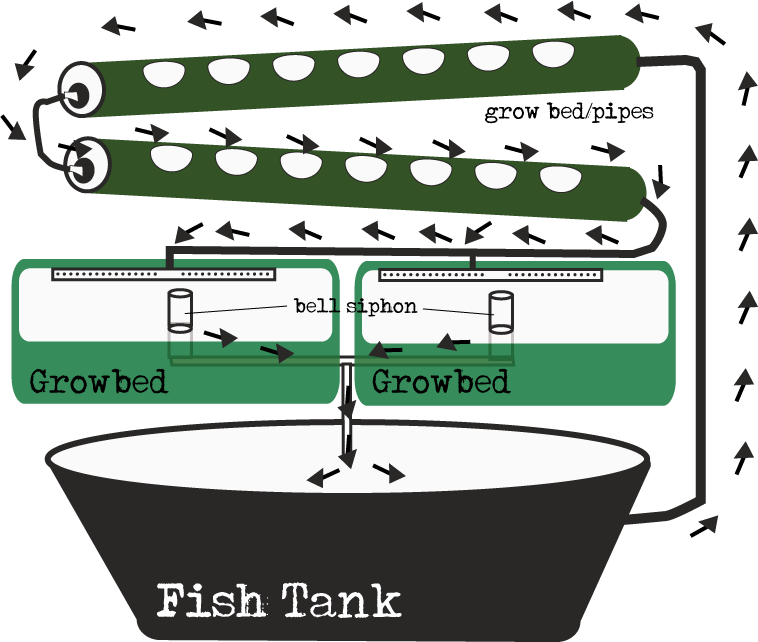
The 2018 Austin backyard build is a more detailed example of a continuously running pump feeding a bell-siphon bed.
How the Flood-and-Drain Cycle Works
- Water enters the media bed and the level rises.
- Roots receive water and dissolved nutrients while water contacts the media.
- The drain arrangement empties the bed; air replaces some water in the pore spaces.
- The next fill begins while circulation and fish oxygen needs remain supported.
Gravity can return water from a raised bed, but a pump still supplies the lift somewhere in the circuit. A draining bed helps renew air around roots; it does not replace an oxygen plan for fish and bacteria.
Bell Siphon or Timed Pump?
| Approach | How the cycle is controlled | What to check |
|---|---|---|
| Continuous pump + bell siphon | The bed fills until the siphon starts, then drains until air breaks the siphon | Compatible inlet flow, outlet geometry, guard access and repeated reliable triggering |
| Timed pump + draining outlet | The pump supplies a flood period; the bed drains through its designed outlet during the off period | Enough drainage during the off interval, safe high-water level and fish/filter needs while the bed pump is off |
A bell siphon does not normally need the bed pump to switch off to drain. A timer alone does not make a bed flood-and-drain: the outlet must let the bed actually empty. Avoid combining controls without understanding how each affects the cycle.
The University of Maryland small-scale build guide illustrates a bell-siphon arrangement; Clemson’s component guide explains flood-and-drain water movement.
Setting Water Levels and Cycle Timing
Set the high-water level below the media surface where appropriate, with an overflow route that protects the bed and the area around it. The low-water level depends on the drain design; not every last drop must leave the bed. Roots should not remain unexpectedly dry between cycles.
There is no universal “20 minutes each hour” schedule for every bed, crop and climate. Test the actual fill and drain behavior at the installed pump flow. Review timing as roots grow and conditions change. If timed bed pumping pauses, fish and the biological filter still need suitable oxygen and water management.
Updated Guidance / What We Recommend Today
The original article suggested slowing circulation at sunset and resting the system at night. Do not copy that as a general operating rule. Fish and bacteria continue using oxygen at night. Plan dependable oxygen supply around the clock and circulation appropriate to the complete system.
Commission the plumbing with water before stocking. Watch repeated full cycles, then simulate pump shutdown and restart. Confirm the tank or sump can accept the returning water without overflowing and the pump cannot run dry as the bed fills.
Flood-and-Drain Troubleshooting
| Problem | Likely areas to inspect | What to do first |
|---|---|---|
| Siphon never starts | Insufficient inlet flow, leaking bell or incompatible outlet | Check the pump’s actual flow, bell seating and outlet before changing dimensions |
| Siphon never breaks | Inlet too strong, air-entry path blocked or outlet backpressure | Inspect air entry, roots and outlet submergence; test changes one at a time |
| Bed stays flooded | Blocked drain or a siphon/control fault | Restore drainage and check the overflow path |
| Bed or tank overflows | Drain capacity, blocked guard or insufficient return-water space | Stop the overflow, clear the fault and test the full operating range |
| Plants wilt between floods | Dry interval, poor wetting, heat or root problems | Check moisture and roots as well as the timer; do not assume more fertilizer is needed |
When Ebb & Flow Is a Good Fit
Consider it when you want a mixed media bed and can reach the siphon or drain for cleaning. It may be less appealing if repeated water-level changes complicate your tank volume or the siphon is difficult to access. The advantage is a managed wetting-and-draining cycle, not a promised yield increase.
Maintenance and Next Steps
- Observe the cycle regularly and after changes to flow or planting.
- Keep the media guard and outlet clear while avoiding unnecessary disturbance of established media.
- Check the pump intake, tank/sump levels, fish behavior and water tests.
- Reassess the design if the siphon needs constant adjustment.
Compare constant-flow media beds if you want to avoid siphon triggering, or drip delivery for distributed outlets. Return to the Media Bed guide for media and structural planning, and the beginner aquaponics hub for the broader learning path.