
Deep Water Culture (DWC), also called raft aquaponics, grows plants in floating rafts with roots extending into a trough of fish-system water. In a typical layout, fish remain in a separate tank and water passes through solids treatment and sufficient biological filtration before reaching the growing trough. The submerged root zone needs dependable oxygen as well as circulation.
DWC is one of the three families in the aquaponics system comparison hub. It differs from Media Bed because roots hang in growing water rather than filling a bed of media.
How a DWC Aquaponics Layout Works
- Fish are fed and produce waste in their tank.
- Mechanical treatment removes solid particles before the plant trough.
- Biological treatment converts dissolved ammonia through nitrite to nitrate.
- Water enters the raft trough, where plants take up available nutrients.
- Water returns to the fish circuit while circulation and aeration maintain suitable conditions.
Some treatment functions can share components or surfaces. Nevertheless, rafts and plant roots should not be assumed to provide all the biofiltration required by the fish load. Plan and verify treatment capacity before stocking.
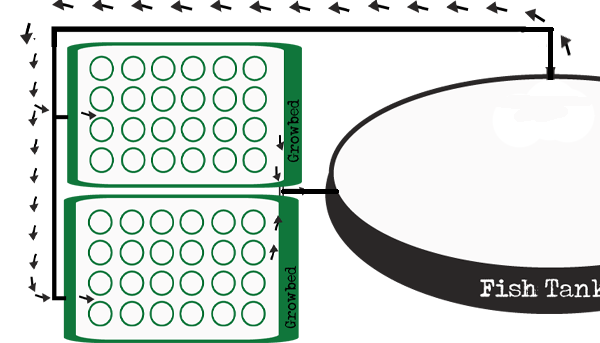
The small-scale aquaponics reference describes fish water moving through filters into the raft bed. Clemson’s component guide explains how solids removal, biological treatment and oxygen support fit together.
Why Solids Removal and Root Oxygen Matter
Keep Excess Solids Out of the Trough
Solids caught among roots and settled in the trough add cleaning work and oxygen demand. Use appropriate upstream treatment with accessible waste removal. Clear-looking water is not proof that mechanical and biological treatment are adequate.
Provide Oxygen Where Roots Grow
Submerged roots, fish and bacteria all need oxygen. Size and distribute aeration for the actual layout, and check that distant parts of the trough are served. A water pump and an air pump do different jobs; circulation alone does not establish adequate dissolved oxygen.
The old article’s “thick, almost syrupy” description of growing water is removed. Viscous or fouled water is not a DWC target. Likewise, filtration and oxygen supply are not optional extras added only to improve performance.
Which Crops Fit a Raft System?
| Crop group | Why consider it | What to plan |
|---|---|---|
| Leafy greens such as lettuce | Rafts support repeated spacing and whole-plant harvests | Season, light, transplant size and harvest access |
| Selected herbs such as basil | Can fit a raft planting pattern | Temperature, root mass, pruning and appropriate spacing |
| Fruiting crops such as tomatoes or peppers | Possible in a deliberately designed system | External supports, mature crop size and greater nutrient management |
DWC is not limited simply to “shallow-rooted plants,” nor does every crop perform equally well. Seedlings need an appropriate support arrangement and access to water without burying the crown. Watch root growth as the plants mature.
Fish Selection Is a Separate Decision
The fish tank remains its own habitat. DWC does not mean trout, tilapia or catfish are “small fish” suitable for the space below the raft. Choose for adult size, temperature, oxygen, legal possession and your tank and treatment capacity. Start with the fish for aquaponics guide and verify species-specific requirements.
DWC vs Media Bed vs NFT
| Question | DWC / Raft | Media Bed | NFT |
|---|---|---|---|
| Where do roots grow? | Hanging in trough water | In media | In a shallow flowing channel |
| What holds the plants? | Raft and seedling supports | Media, plus supports for tall crops | Channel planting positions |
| Where are solids handled? | Plan upstream mechanical treatment | Bed may capture solids, with cleaning or prefiltration as needed | Upstream treatment protects channels and roots |
| What failure deserves attention? | Loss of root-zone oxygen or fish oxygen | Drain blockage or poor wetting/oxygen | Interrupted flow and channel obstruction |
For a mixed backyard bed, examine Media Bed first. For channels, read the existing NFT guide. Return to system selection for the broader trade-offs.
Designing a Home Raft Trough
- Choose a container, liner and raft material suitable for the intended growing use; do not assume any insulation foam or salvaged container is suitable.
- Leave access to inspect roots and remove rafts without disturbing the entire crop.
- Plan seedling spacing for mature plants and prevent large exposed water surfaces where practical.
- Account for the weight of the filled trough and supports.
- Provide accessible inlets, outlets and cleaning points.
- Make room for filters, aeration equipment and any sump, not only the growing surface.
- Test shutdown drain-back, overflow routes and restart behavior.
A trough’s water depth, flow and raft spacing depend on crop roots and the complete hydraulic layout. Copying one published depth is not a substitute for designing the full system. Fish feed supplies much of the nutrient input, but nutrient supplements may still be needed; additions must be compatible with the connected fish and bacteria.
What DWC Can Offer—and What It Costs to Maintain
Useful Features
- An orderly planting pattern for suitable greens and herbs.
- Movable rafts can make crop handling practical.
- Water is reused within the connected system.
Responsibilities
- Substantial water weight and space for treatment equipment.
- Dependable root-zone aeration and a power-failure response.
- Filter and trough cleaning, seedling production and root inspection.
- Nutrient and temperature management; no automatic faster-growth or profitability promise.
Routine Checks and Troubleshooting
| Symptom | Inspect | Practical response |
|---|---|---|
| Poor root condition or plant wilting | Oxygen supply, water temperature, roots and solids | Restore suitable aeration and investigate the root environment |
| Sediment or debris among roots | Upstream filters and solids removal | Clean appropriately and correct the source of accumulation |
| Algae on exposed water | Light reaching the water, gaps and maintenance | Reduce unnecessary exposure with appropriate covers; avoid unverified algicides |
| Weak growth or pale leaves | Light, temperature, pH and nutrients | Diagnose before adding fertilizer; do not adjust only for the crop while ignoring fish |
| Aeration or circulation stops | Power, pumps, connections and blockages | Implement the fish/root oxygen contingency and restore the failed equipment safely |
Observe fish, flow and air delivery regularly, and increase testing during startup, load changes or faults. Set chemical testing to the system’s stability and species needs rather than treating “once a week” as a universal safe interval.
Where UFF’s Experience Fits
UFF’s Austin backyard build and patio IBC project document media-bed installations. They help explain shared plumbing and maintenance planning, but they are not firsthand DWC trials. This page makes no claim that UFF tested raft productivity or compared commercial yields.
Before You Build
Use the beginner aquaponics hub to prepare for cycling and fish care, then compare the complete system options. If choosing DWC, make a parts plan for the tank, treatment, trough, rafts, circulation, aeration and failure response before visiting the supplies page.



Leave a Reply