
Types of Aquaponics Systems: Which One Should You Choose?
The three main plant-growing methods in aquaponics are Media Bed, Deep Water Culture (DWC / Raft), and Nutrient Film Technique (NFT). Choose by the crops you want, the space you can maintain and the filtration and oxygen supply you can provide. Flood-and-drain, constant-flow and drip are ways to deliver water within a media-bed design, rather than three additional top-level families.
If the concept is new to you, read what aquaponics is and how it works. For the wider planning pathway, use the beginner aquaponics guide. This page helps you choose the plant-growing part of the system.
Compare Media Bed, DWC and NFT
| System family | Where roots grow | Useful starting crops | Filtration and oxygen | Main trade-off |
|---|---|---|---|---|
| Media Bed | In expanded clay or suitable gravel | A mixed garden of leafy greens, herbs and supported fruiting crops | Media provides bacterial surfaces and can trap solids; loading, cleaning and aeration still matter | A flexible garden layout, with a heavy bed and drain maintenance |
| DWC / Raft | Hanging from rafts into a growing trough | Lettuce and selected herbs; larger crops need more support and nutrient planning | Plan solids removal and sufficient biofiltration before the trough; oxygen must reach submerged roots | Useful for repeated plant spacing, with extra water weight and aeration to manage |
| NFT | In channels carrying a shallow film of water | Compact leafy greens and herbs suited to the channels | Remove solids upstream and provide biofiltration; keep channel flow dependable | Can fit narrow spaces, but roots and debris can obstruct flow and roots can dry when flow stops |
These are plant units connected to a fish-care system, not substitutes for one. University extension’s small-scale overview describes the three families and their shared equipment.
The Three Main System Families
Media Bed
Plants root in a bed of media. It is a practical starting point for a small mixed backyard garden when you can support and reach the bed.
Understand media-bed design and its three water-delivery options
Deep Water Culture / Raft
Plants sit in rafts above an aerated growing trough. It is worth considering when you want an orderly crop of greens and have room for filtration, water and maintenance access.
Nutrient Film Technique
Roots receive a shallow moving film in growing channels. Choose it for crops that fit the channels and a layout you can inspect, flush and protect from flow interruptions.
Choose for Your Garden, Not Just the Smallest Footprint
| Your goal or constraint | First option to examine | What to check before deciding |
|---|---|---|
| A first mixed vegetable-and-herb bed | Media Bed | Weight, access, media choice and a reliable drain |
| Repeated lettuce or herb harvests | DWC / Raft | Seedling space, raft spacing, solids filters and root-zone aeration |
| A narrow growing area | NFT | Channel access, root space, upstream filtration and backup plans |
| Large fruiting crops | Media Bed or a designed media-container layout | Trellis support, mature crop size and nutrient demand |
| Unreliable electricity | Compare the failure plan for every option | Fish oxygen, circulation and an appropriate backup; no family is outage-proof |
| Limited daily attention | Simplify the system before adding automation | You still need regular checks, fish care and prompt fault response |
For a first home build, a modest media bed is often worth evaluating before channels or rafts. It lets you see the roots’ growing environment and combines several functions. That does not make it maintenance-free or guarantee lower total cost. Price a complete parts list, including filters, air supply, tests, safe supports and replacement parts.
Media Bed: Flood-and-Drain, Constant-Flow or Drip?
| Configuration | What the water does | Main point to assess |
|---|---|---|
| Flood & Drain / Ebb & Flow | The bed fills and drains, using a timer/drain arrangement or an autosiphon | Drain reliability, cycling water levels and oxygen supply |
| Constant-Flow Media Bed | Water enters continuously and returns through a drain; a constant-flood bed keeps a set water level | Water distribution, drain access and oxygen in the wet root zone |
| Drip / Timed Delivery | A manifold or outlets deliver water near roots in media | Clogging, even delivery and a return route |
A pump that runs continuously can feed a bell siphon that repeatedly floods and drains a bed. Continuous pumping does not necessarily mean a constant water level. Rafts and NFT may also have continuous flow, but that does not make them media beds.
What Every System Still Needs
- A suitable fish tank and a realistic feeding and stocking plan.
- Solids management and enough biological filtration for the intended waste load.
- Water circulation, aeration and a way to notice failures.
- Temperature, light and crop conditions you can maintain.
- Accessible drains, safe supports and water testing before and after stocking.
Choose fish for their own requirements using the fish for aquaponics guide; the growing method alone does not decide the species. Before buying parts, sketch tank, filters, beds, return and any sump. Trace both normal flow and where water will go when power stops.
Learn from Real Urban Fish Farmer Builds
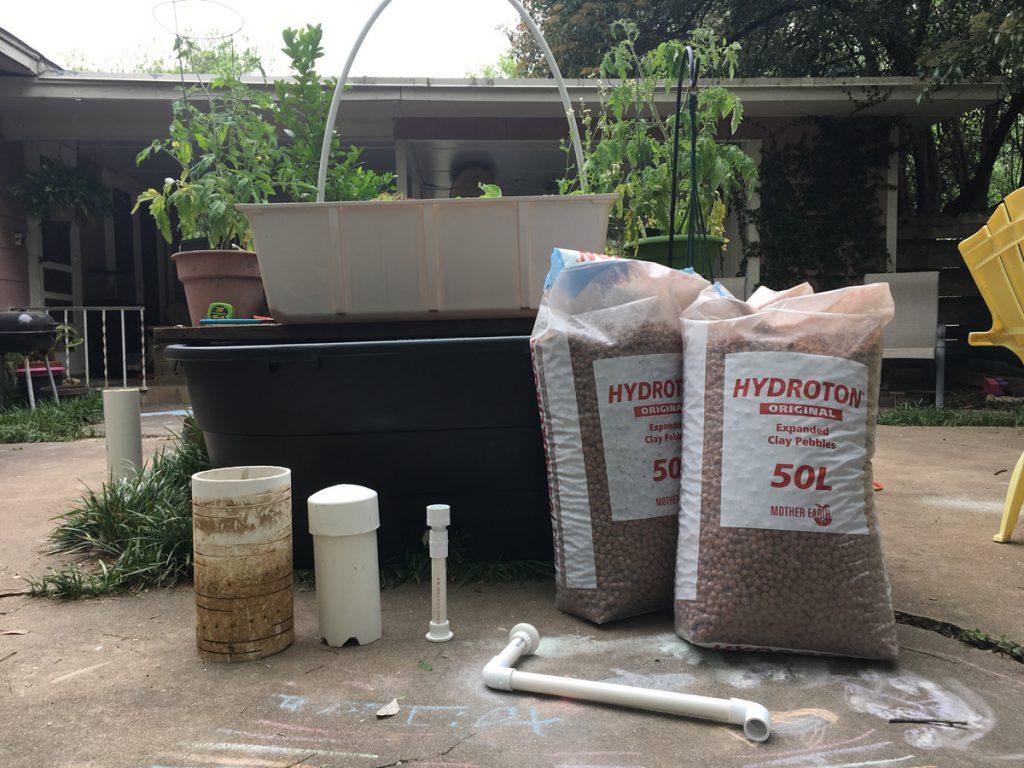
Austin Backyard Garden
The Austin installation shows a media bed, continuous pump and bell siphon. Its changing bed water level makes it flood-and-drain despite the article’s older “constant flow” wording.

Patio IBC Project
The patio IBC project documents a media bed with later growing tubes. A hybrid can add crop space, but each added branch needs dependable flow and access.
Updated guidance: use these historical builds to understand layout choices. Reassess old startup schedules, fish counts and pump specifications before copying them. A photographed build is not a guarantee of a present-day yield.
Can You Combine System Types?
Yes. A hybrid might combine a media bed with a separate raft trough or channels. Treat each branch as another demand on filtration, flow and maintenance. Start with one working growing area; add another only after you know how the first behaves. A series layout also needs an overflow plan if the first branch blocks.
Before You Commit to a Layout
- Measure usable space and leave room to reach fish, plants and filters.
- Select crops and fish for your actual seasonal conditions.
- Check tank, bed and stand capacity when filled with water and wet media.
- Work out operating water levels and the volume that drains back at shutdown.
- Check the pump’s flow at the real lift and the drains’ ability to handle that flow.
- Plan oxygen supply and a power-failure response.
- Commission the plumbing and biological filter before stocking.
Ready for the detail? Start with Media Bed, DWC / Raft or NFT. Use the aquaponics supplies page after you have identified the job each component must do.